
Utah Acupuncture Licensing, Redux
plus an updated guide to state acupuncture laws!


On February 12, I testified in a hearing of the Utah Legislature’s House Business, Labor, and Commerce Committee regarding acupuncture licensing reform, and apparently there’s some, ah, lively discussion about that amongst acupuncturists, so let me set the record straight. I would’ve posted about this sooner but WCA’s needs took precedence (5NP, changes to our Rockwood clinic). Spoiler alert, this post is not an apology.1
And for clarification, our acupuncture school isn’t trying to expand to Utah; I was testifying at the request of another licensed acupuncturist (not a community acupuncturist) who is hoping to open an acupuncture school there. Here’s the testimony I submitted —I didn’t get to say all of it in the hearing because I had to talk really fast! Nevertheless, this is what I’ll go on the record for, any chance I get:
Chair Maloy, Vice Chair Kyle, and Members of the House Business, Labor, and Commerce Committee, regarding House Bill 202, Acupuncturist Licensing Amendments, in Support:
Thank you for hearing testimony on the important topic of licensing reform for acupuncturists, and for considering an alternate model for acupuncture education. Both are greatly needed.
My name is Lisa Rohleder and I’m a licensed acupuncturist and the founder of a nonprofit, accredited acupuncture school in Oregon. My goal is to provide some context for HB 202 and, I hope, answer some questions that came up in the previous hearing about program hours, curriculum, and the role of credentialing exams.
Before I founded an acupuncture school, I was an employer of acupuncturists, in a cooperative with other employers. The high cost of education was a major problem for us, because acupuncturists graduate with so much student debt — often more than a hundred thousand dollars — that our wages couldn’t possibly match up.2 And the cost of acupuncture school just kept rising, due to the unlimited availability of federal student loan funding. We realized that the only answer was to build our own school, where we could try every possible strategy to contain costs for the students.
We started our school in 2014 with the lowest number of hours we could have for an entry level acupuncture program (1905) but over time, we realized we could trim the curriculum further. We recently proposed a 1350 hour entry level program to our accreditor — which is the same number of hours that HB 202 is proposing — so I’d like to give some context for how we came up with those numbers.
If you look at many different kinds of healthcare trainings, there’s a consistent requirement for 500 hours of supervised clinical internship. That seems to be a baseline across disciplines. And in our experience, 500 hours of supervised clinical internship is a solid basis to prepare graduates for entry-level employment and independent practice. The clinical internship is where the core learning happens; patients are always the best teachers.
So then it’s a matter of figuring out, how many didactic classroom hours are required to get students ready for that 500 hour internship and to understand what they’re learning once they’re treating patients under the guidance of a supervisor. In terms of instruction in acupuncture diagnosis, treatment and related techniques, we think 450 classroom hours — almost equivalent to the internship hours — is enough to address what students need.
In addition, we require students to take 2 terms of anatomy and physiology, which they can generally complete at a community college, and we also include classes in red flag referrals and communication with biomedical providers, so that students understand when they need to refer patients out for safety reasons. We allocate about 225 hours for biomedical topics. And so overall it works out to the 500 hour internship taking up about 40% of the program, with didactic classes taking up the remaining 60%.
We always keep in mind that the goal of the program is not to teach students everything they might ever want to know about acupuncture, but to get them to the point that they can practice safely and competently without supervision.
Safety of course is a paramount concern. Simply adding hours to programs doesn’t necessarily result in safer or more effective graduates, it just results in bloated programs. Part of building an acupuncture school is accounting for what happens in every single hour of the program as well as writing detailed job descriptions for every position in the school, including clinical supervisors. Having done that myself, I can testify that teaching acupuncture safety does not require thousands of hours; it’s actually fairly straightforward to address important topics like needling depth, clean needle technique, blood-borne pathogens, and possible adverse events. The most important part of teaching safety happens within the 500 supervised clinical internship hours, where students learn first hand how to practice safely when they’re treating members of the public.
I would like to address the role of the NCBAHM credentialing exams from my perspective as both a school founder and employer. In fact, we have a student in our program who will graduate this year who has a job waiting for her at an acupuncture clinic in Salt Lake City. I can testify that the NCBAHM credentialing process functions only as a barrier for her and for her employer. NCBAHM’s tests do not measure the most important skills and competencies that she acquired in our program.
The intention behind the NCBAHM exams may be public safety, but the impact of the NCBAHM exams is anti-competitive. I know multiple acupuncture employers (including my own clinic) who have had to wait to fill positions because qualified candidates had to spend up to a year, along with thousands of dollars, to get through the NCBAHM credentialing process. Because NCBAHM has a functional monopoly on credentialing in most states, they’re accountable to nobody. Many of us, both educators and employers, have pleaded for changes to their tests and have been ignored. Please forgive me for venting my frustrations as an employer here, but it’s rare that anybody is actually interested in the impact of NCBAHM on the acupuncture workforce.
Thank you for your attention to these details of acupuncture education and credentialing, and thank you for considering licensing law reform for acupuncturists in Utah.
Amidst all the consternation about the new federal limits on student aid, I haven’t seen anybody bring up NCBAHM’s role in the crisis. I’ll go on the record about this too: the NCBAHM credentialing process contributes significantly to acupuncture’s terrible debt to income ratio — because the NCBAHM exams don’t test for entry-level competency in acupuncture. The NCBAHM exams are a certification in Traditional Chinese Medicine theory, which isn’t the same thing at all.
Getting through the exams tacks on an additional six months to a year of studying for most graduates — six months to a year when they can’t work as acupuncturists — and sometimes it weeds out altogether people who would otherwise be safe, competent, talented practitioners, simply because they’re not good test-takers or they’re not good at parsing TCM theory under pressure. I can’t write any more on that topic without ranting, so I’m going to move on to the other thing I wanted to share with you, which is a new resource.
Courtesy of Elizabeth Ropp of the POCA Cooperative, Maddie Foley of Acupuncture for the People, and their crew of intrepid volunteers, here’s an up to date spreadsheet of acupuncture licensing laws in the US. This document is going to be very important for navigating the acupocalypse:
A Modern Guide to State Acupuncture Laws
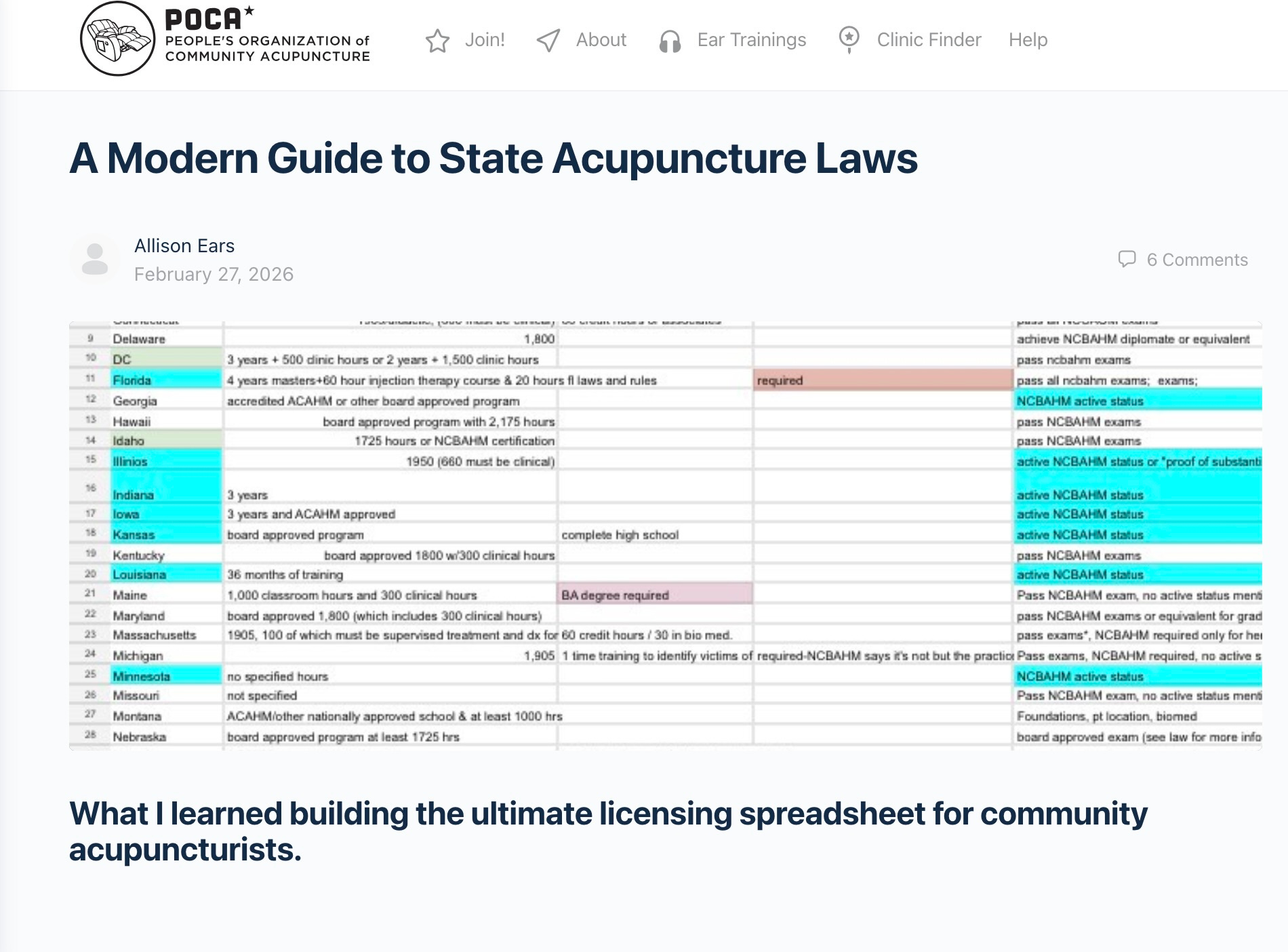
For anyone who’s new to our world, it’s worth taking a look, just to get a sense of the inconsistent regulatory patchwork the acupuncture profession has created for itself. The fact that this document didn’t exist until (*checks calendar*) three weeks ago should tell you something about how much attention most acupuncturists, including major organizations, have been paying to the problem.3 And acupuncturists’ apoplectic reaction to Utah’s HB 202 should tell you how unwilling the acupuncture profession is to adapt and evolve.
Also, I think we’re getting to a phase in the acupocalypse that I didn’t anticipate and that I’m not excited about, which is the brainstorming phase, where people throw out all kinds of ideas about how to address the crisis. As I said in an earlier post about meetings,
Brainstorming can be a fun group activity! But brainstorming can also give the false impression that anything is possible, and everybody in the organization can weigh on in anything they might be interested in, without taking any responsibility for execution. I’ve been in some truly awful acupuncture-organization meetings where all anyone wanted to do was brainstorm, constantly, as a way of avoiding reality.
There’s a very big difference between having ideas and actually making things (like schools) that can function within real-world limits of time, resources, and regulation. Having spent a couple of decades immersed in the latter (with the scars to prove it) I don’t have a lot of patience for the former.
I’m glad the state law spreadsheet exists as a resource for other people who might want to actually make things. And in other news, I’m participating in an online panel discussion on the future of acupuncture education, hosted by the White Pine Community on Saturday, March 21, details here.
For a post about the last time I testified about acupuncture licensing to Utah’s Department of Professional Licensing (DOPL) back in 2018, see On 5NP, Inclusion, and Holding Space.
Nobody’s wages can match up to an acupuncture education that costs upwards of $200K. See:
To be fair there was a 2014 version created by the National Policy Group (that group is now defunct, I believe) and shared by The Acupuncture Observer’s Elaine Wolf Komarow.
A lot of work in getting this done. Congrats.
To make matters more complex, if you put together the scope of practice in each state, you would see there is no logical relationship to education requirements and scope as there should be. Then, factor in the different titles for practitioners and it is about as illogical as you could dream up.
When I was still a consultant with American Specialty Health, they had by far the most comprehensive database of everything - scope, education, exams/licensing requirements, titles, CEUs/PDAs, etc. I had brought in Barbara Mitchell to help them get this started and then they would renew that database every year. They do that for all of their specialties on an ongoing basis but Acupuncturists was the most unwieldy of all.
Fantastic. Is it okay if I put a link to the new list on the Observer?