
Acupocalypse Now

I’ve been thinking and writing about the acupuncture profession’s debt to income ratio and its consequences for twenty years or so. (Most recently, the Cockroaches of Acupuncture series in 2024.) Nonetheless I’m alarmed by what’s coming out of the Department of Education in the last three weeks. Really alarmed! Big thanks to Ryan Hofer of Debt by Natural Causes for wading through all of the announcements, the slideshows and the data — I wouldn’t have seen the gory details otherwise — and for helping me think through the possibilities.
But before I get into all that, I’d like to note that not everybody’s alarmed — and that’s important. According to Inside Higher Ed:
After a week of talks and a final compromise from the Education Department, an advisory committee on (January 9th) signed off on regulations that would require all postsecondary programs to pass a single earnings test. The new accountability metric, set to take effect in July, could eventually cut failing programs off from all federal student aid funds—an enhanced penalty that appeared key to the committee reaching consensus Friday…committee members praised the compromise as “reasonable’ and “common-sense.”
…About 6 percent of all programs would fail the combined earnings test.
That would affect less than 5% of students receiving federal aid. You can practically hear the sighs of relief.
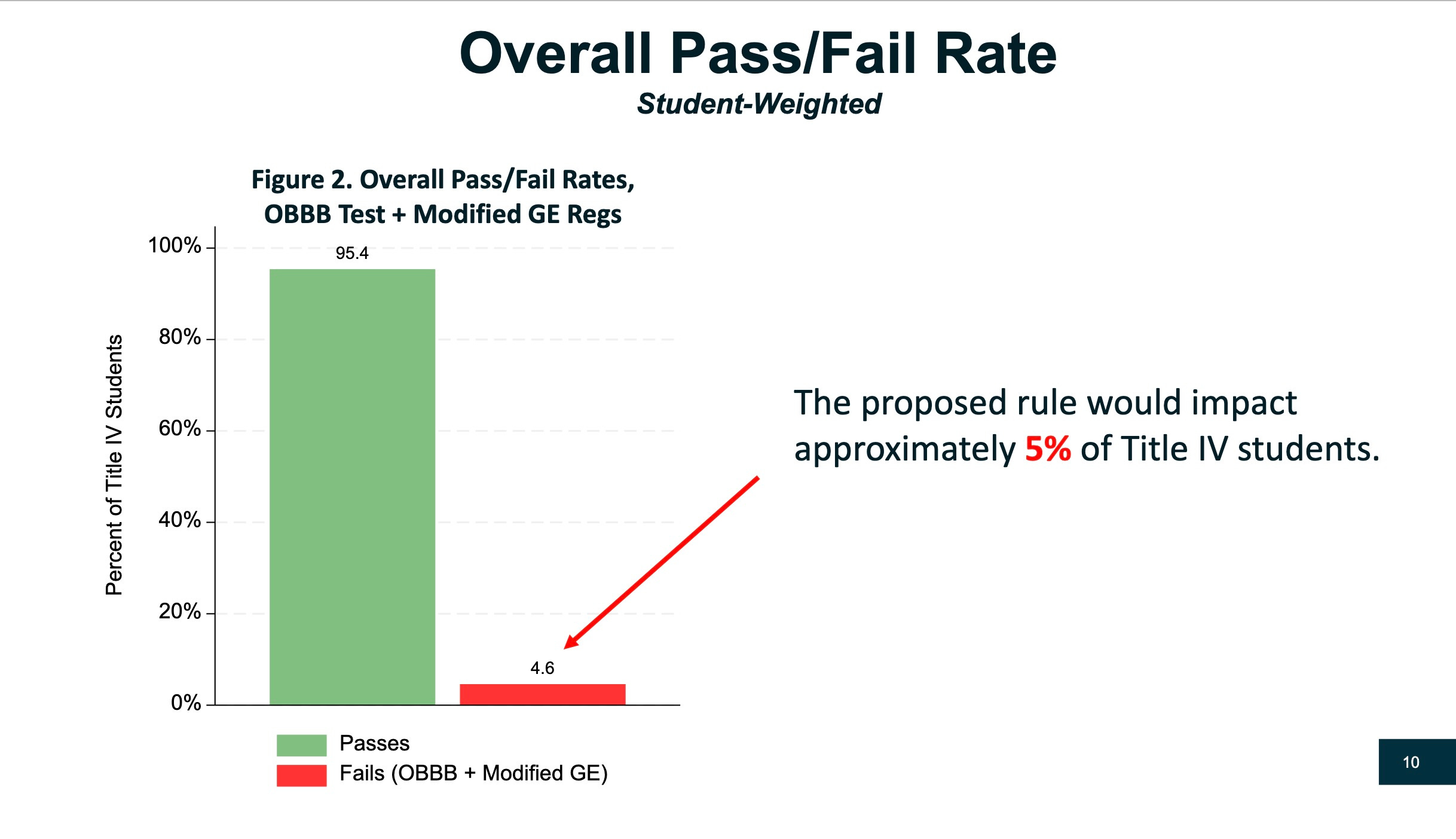
For as long as student loan accountability has been under discussion — since 2010 by my count — there’s been concern that these measures would have a sweeping, unfair impact. That seems to have changed, decisively. From what I’m reading now, those concerns seem resolved and now there’s bipartisan support for the accountability regulations because they seem reasonable to almost everybody, and maybe even not such a big deal? They’ll affect relatively few students, and in terms of programs, only the worst offenders.
And who are the worst offenders, according to the Department of Education?
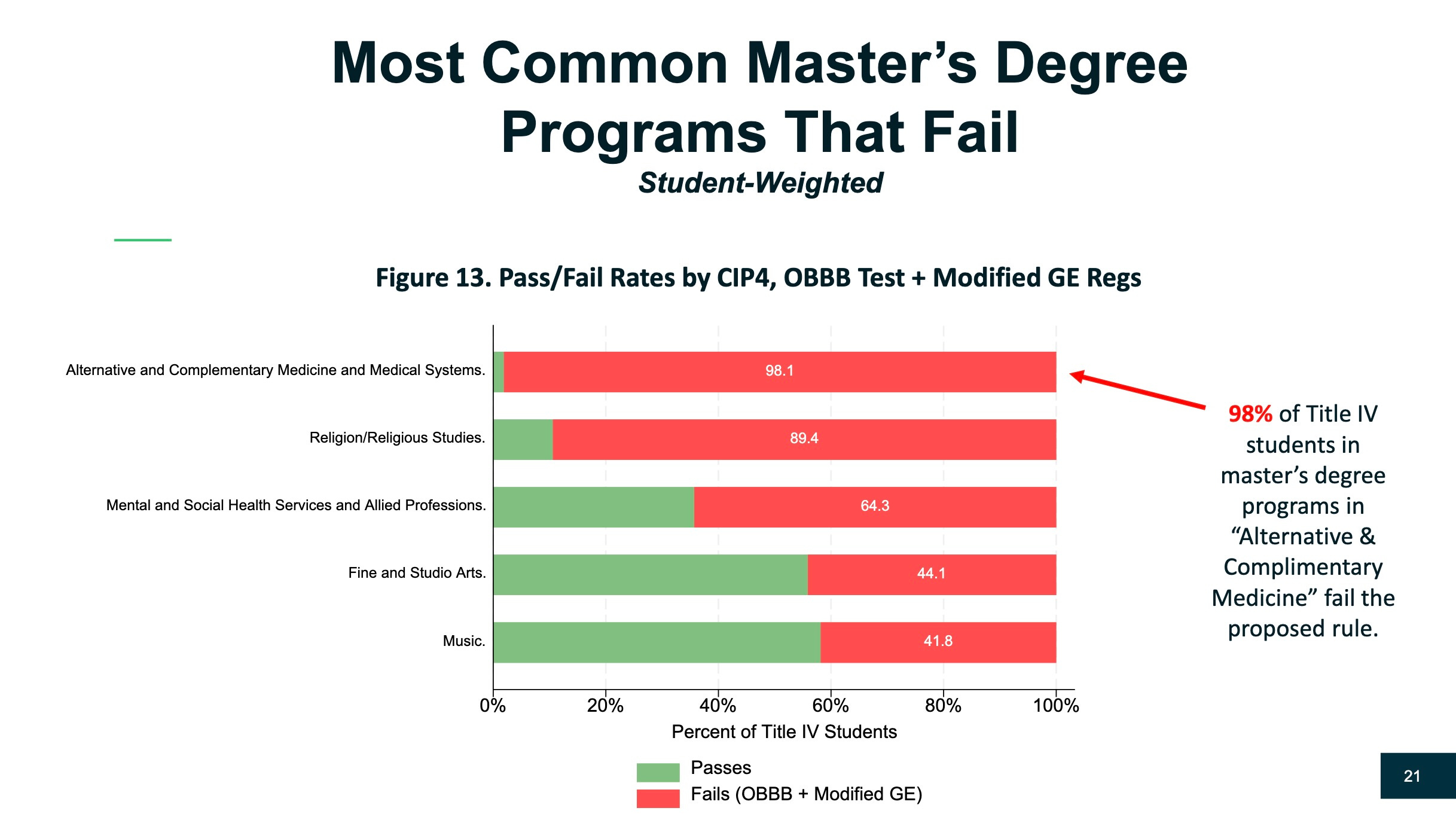
We are. In terms of master’s degrees, alternative medicine programs are literally the worst.
This shouldn’t be news, because that’s exactly the conclusion that Oregon Public Broadcasting’s consumer protection investigation came to in 2024 — we’re the worst! But it’s not like OPB could do anything about it.
The Department of Education can, though. Starting in 2027, current and prospective students in failing programs will be notified, and starting in July 2028, programs will begin to lose access to student aid. This threat has been hanging over the acupuncture profession for so long now that I think many people got the impression that it wasn’t really going to happen. I’ve had the same feeling myself; even though I was obsessed with this topic, it felt sort of abstract?
Those slideshows and those graphs, though, feel very concrete. This time, I think the Department of Education means it; it looks like they’re going to follow through. And nobody outside our world will complain if acupuncture schools are cut off from federal student aid — because there’s so much evidence that we deserve it. We shouldn’t expect anybody to defend us because we’re not sympathetic characters in this drama. We’re the villains! I mean, music and fine arts degrees look good in comparison.
I think this news about the consensus on the earnings test is the last and clearest warning we’re going to get. Now, right now, is the most notice we’re ever going to have about the acupocalypse. We might have only a year before the accountability measures start having an impact. That’s significantly less time than I was expecting.
We need to imagine — right now! —what the acupuncture profession’s going to look like if all the student loan money gets sucked out of it in the next two to five years.
Let’s review how the national infrastructure of the acupuncture profession is funded:
First we have the national credentialing body, NCBAHM, which defines entry level competencies in acupuncture for every regulated state except California.1 More than half of NCBAHM’s revenue comes from people entering the profession — which is revenue that’s predominantly sourced from federal student loans.
Next we have CCAHM, or the national membership organization for acupuncture schools. Most of CCAHM’s revenue comes from administering the Clean Needle Technique exam — which is also taken mostly by people entering the profession. They’re paying for their CNT exam with federal student loans. (The remainder of CCAHM’s revenue comes from membership dues from schools that almost all depend on federal student loans).
Then we have ACAHM, the national accrediting body for acupuncture schools. ACAHM’s revenue also comes from schools that almost all depend on federal student aid.
Only the American Society of Acupuncturists, the national membership organization for acupuncturists, isn’t directly supported by student loans. The ASA also has no money to speak of — go figure!
You see the problem? Three out of four pillars of the national infrastructure of the acupuncture profession are about to get walloped in their revenue streams. Probably catastrophically. Starting in 2028, if not sooner. And I see no signs whatsoever that anybody in any of those organizations is making preparations for this level of economic disruption.

Of course there are a number of unknowns in how the acupocalypse will play out. Here are the unknowns that I can think of — if I’m missing any, please say so in the comments, or send me an email.
First, the role of private student loans. How many students will take out private loans — and even more importantly, how many private lenders will be willing to offer their products to an industry that’s been publicly labeled as the worst? Tuition and living expenses for an acupuncture education don’t add up to trivial sums, and even the most unscrupulous lenders want to be repaid. Many acupuncture school graduates say that federal student loan debt has ruined their lives; private lenders with unabashedly predatory interest rates would be even worse.
Because of the federal student loan caps that kick in this summer, we’ll probably get some information relatively soon about how private lenders feel about investing in our sector, and how acupuncture students feel about taking out private loans. The loan caps themselves will probably cause some schools to close, so 2026 should offer a kind of preview for the main event — which is the impact of the accountability measures, starting when the earnings test is applied in 2027.
Second, will individual states step into the student funding breach? Maybe, but we don’t know what kind of accountability measures state loans themselves might have, and we don’t know how many states will attempt this. Our problem is that the national infrastructure for our profession has been funded, for the last 30+ years, through a national program…that we no longer qualify for.
Third, might a lawsuit from affected schools slow down the implementation of the new regulations? In 2017, a group of twelve acupuncture schools tried to sue the Department of Education over their failing Gainful Employment grades; I don’t know what happened with that lawsuit exactly, or if they’ll try again, or if the cosmetology schools (who have similar problems) will try again. (They lost.)
Fourth, how incentives for schools to teach-out failing programs will impact the timing of the acupocalypse. According to the Institute for College Access and Success:
(The Dept of Education) agreed to add a process proposed by the non-profit institution negotiator that would allow programs that fail to meet the earnings threshold test in one year to elect to close the program while retaining access to Direct Loans for a limited amount of time. This provision is intended to allow currently enrolled students to complete their program or transfer to a higher earnings outcome program, while preventing institutions from enrolling new students in that program or starting a substantially similar program for at least two award years following closure.
Or, in a similar vein, how new public warnings to students and prospective students about the looming loss of federal student loans will impact enrollment. From the same TICAS article:
Institutions must provide warnings notifying current and prospective students that a program may become ineligible for the Direct Loan program due to failure to meet the earnings premium measure. The warning must indicate that the program has not passed the earnings premium metric and may lose access to Direct Loans, as well as the relevant information to access the Department’s program information website. Students must acknowledge having viewed the warning before the institution can disburse Title IV funds to them. ED accepted the proposal from the legal aid and student negotiators to retain the requirement to issue a follow-up warning if the student enrolls more than 12 months after receiving the initial warning.
Fifth, there’s the question of whether the schools and the national organizations have the will and the ability to adapt to this new environment and its radically diminished resources. As you know, I believe that all kinds of organizations can be run on a shoestring budget, without federal funding, but I’ve got a feeling most of the current professional leadership would disagree. It’s not an exaggeration to say that most other acupuncture schools would rather die than be like us — which, you know, I try not to take too personally. See also:
Almost all the organizations in the acupuncture profession are about to be dropped into the world that we live in, where people have to worry about how to pay for necessities.
Sixth — and related — there’s how much acupuncturists themselves will resist any attempts to adapt to an environment where our professional infrastructure is no longer funded by the government. Given what I know of acupuncturists, I expect they’ll resist strenuously! For example, this seems like a great time to consider a new lowest common denominator for entry level acupuncture education — remember the 2 year Masters degree that students could potentially pay for out of pocket? However, that would require changing a number of state licensing laws and I expect many acupuncturists will fight tooth and nail against “lowering standards”. Even if almost all the existing programs close because hardly anybody can afford them without federal loans.
Regardless of the uncertainties, though, there’s one thing we can do right now and we should do it — ask every organization in the acupuncture profession: If all the federal student loan money gets sucked out of the acupuncture profession in the next two to five years, what exactly are you going to do?
We need to see some contingency plans. Otherwise the next few years are going to be pure chaos, especially for current acupuncture students.
I’ll go first: My school doesn’t depend on student loan money; it was built to not need it, so on that count we’re fine. What’s going to be more problematic is how our graduates become licensed if the entire national professional infrastructure collapses. (Which is why I’m so interested in hearing from other organizations, so that we can plan accordingly!) Professional infrastructure was built by humans, it didn’t fall from the sky, so it can be rebuilt by humans, even when resources are limited. There’s no time like the present!
Late edit/teaser: After I wrote this post, I reached out to a representative of the AHM Coalition (the acupuncture industry’s super-group) and asked what their plan was. They said that they’re aware of this “existential threat to the profession”, they’re working on it, and we can expect to hear from them soon. For the first time ever, though, this representative and I were in agreement about how dire the situation is. Follow-up post with more details, coming Thursday. Apologies for the cliffhanger — I need some time to digest this.
California has some professional infrastructure for acupuncturists that’s not funded by student loans, in the form of the California Acupuncture Board. The CAB serves as a licensing and credentialing body for California. That’s not going to save California acupuncture schools themselves from these new regulations, though, and it doesn’t help all the other states where NCBAHM and ACAHM are written into the licensing laws.
So, Lisa, as I think you know, I am doing my best on the other end of the tally – how we could take steps to increase demand for acupuncture services and increase the earnings of the average Acupuncturists. However, I know my proposals are a long shot (because they rely on people actually working together on new and novel ideas) and, at best, it would take years to grind away and make real progress on earnings.
But, I have also long believed the cost of training was way too high, and we had too many schools and would one day need to wean that number of schools down to a lower number of better schools.
I do have an idea, though, regarding the schools I wanted to share with you and your readers (especially knowing Ryan Hofer reads your series). I was recently contacted by someone that really wants to become an Acupuncturists and asked me if I would consider working with her under the California Tutorial Program.
As I was thinking about this and started talking with this person, I had the thought that maybe some sort of hybrid tutorial programs could provide some sort of lifeline for schools, teachers and students. There are going to be quite a few teachers laid off and quite a few schools in real threat together with the other pillars of the profession as you articulated.
Might there be some sort of way to make the tutorial path to licensure an actual viable thing? You would know a lot more about that than I do.
Apprenticeships or tutorials have, of course, been the way this medicine was primarily handed down over these last 2,000 years. And now, we have these huge problems with school costs and closures. I’m not suggesting tutorial programs would solve all these problems, but I suspect the schools would have historically been against the idea of facilitating tutorials because they were a kind of less expensive competition. Could they now be a bit of a lifeline the schools could seriously consider?
Even without new graduates taking the NCBAHM exams, that org gets revenue from the rest of us who recertify, even if we don’t have to by state law. If L.Acs want jobs in hospitals, federal facilities like the VA, or be able to bill insurance the cost to entry is active status with NCBAHM. They could just raise their renewal fees.
And they have $5 million in assets.
At least that’s what my AI chatbot tells me.