
Acupocalypse FAQs

People are starting to pay attention to the acupocalypse and overall that’s a good thing. Recently I helped another organization draft some FAQs so I thought, maybe I should share those here — and then I thought, actually I’d like to write my own version. So this post is a mash-up of actual FAQs plus some, ah, unfiltered personal commentary. (Content note, and apologies in advance, for swearing.)
Who coined the term “acupocalypse”?
My friend Whitney, who’s hilarious. (She’s one of the founders of Sacramento Acupuncture Project/Oakland Acupuncture Project and she also came up with “cockroaches of acupuncture”. ) I’ve spent many hours laugh-crying with Whitney over the state of the acupuncture profession.
What does “acupocalypse” mean?
Due to impending changes in how federal student loans are regulated, most existing acupuncture schools will lose access to federal funding. And most are unlikely to survive the loss. This means that the pipeline for new L.Acs entering the profession is narrowing drastically or even collapsing. This in turn will impact major organizations that make up the national infrastructure of the acupuncture profession like NCBAHM, ACAHM, and CCAHM.
Are current L.Acs’ licenses at risk?
There is no reason to believe that they are. Even if national infrastructure is impacted and regulations change at a state level, current L.Acs are likely to be grandfathered in to whatever comes next. (Though now might be a good time to take a look at your state’s acupuncture law.)
What are the long term potential impacts for acupuncturists?
In the long run, the best analogy is to a species becoming extinct. If we can’t train new L.Acs, we will die out as a profession. Acupuncture may be provided by other professions, but licensed acupuncturists will be a thing of the past. In the interim, many current L.Acs will be delighted, because they’re so short-sighted and selfish that all they can think about is how there will be less competition.
Wow, Lisa, tell us what you really think. Are you out of fucks to give?
Why yes, I am.
Anyway, as I was saying — depending on how fast attrition occurs, some of the ancillary businesses that have grown up around the acupuncture profession like needle companies, herb companies, CEU providers, and malpractice companies, will suffer and may even go out of business as the number of L.Acs drops. It’s like an ecosystem collapsing.
For exactly how long have you seen this coming?
For at least 20 years, which I hope explains my irritability about it.
One evening (maybe in 2008?) a young woman showed up at WCA, toddler in tow, and asked if we had any job openings for acupuncturists. I asked if she was interested in community acupuncture and she said no, not particularly. She explained that her welfare caseworker was making her go to every acupuncture clinic in town and ask for a job, even though none of them were hiring.
There’s an argument — that never ceases to infuriate me — about the acupuncture profession’s debt-to-income problem that goes: so many young women attend acupuncture school who decide to have babies and then voluntarily choose part-time employment, that it makes the acupuncture profession look bad.1 In other words, there’s nothing wrong with the acupuncture profession except that it’s full of girls!
Yeah, well, part-time employment is only voluntary if there’s a full-time alternative which there usually isn’t, and then there’s the part about how those young women were recruited to acupuncture school with the promise of “a flexible career”. Nothing is more flexible than something that exists only in your imagination! Anyway, the acupuncturist who came to WCA looking for a job had believed those promises. She had a baby in her last year of school at OCOM; right after graduation her partner left, so then she was a single mom on public benefits, being pushed to find employment where there wasn’t any. She was in no position to start her own practice even if her school had prepared her, which it didn’t.
I didn’t think this situation was her fault, I thought it seemed more like a structural problem — and someday, there’d be hell to pay.
Every survey I’ve ever seen about acupuncturist income — since I started digging for this information in the 2000s — has looked basically the same. They all look like this table, which is from the most recent NCBAHM Job Analysis (pg 31):
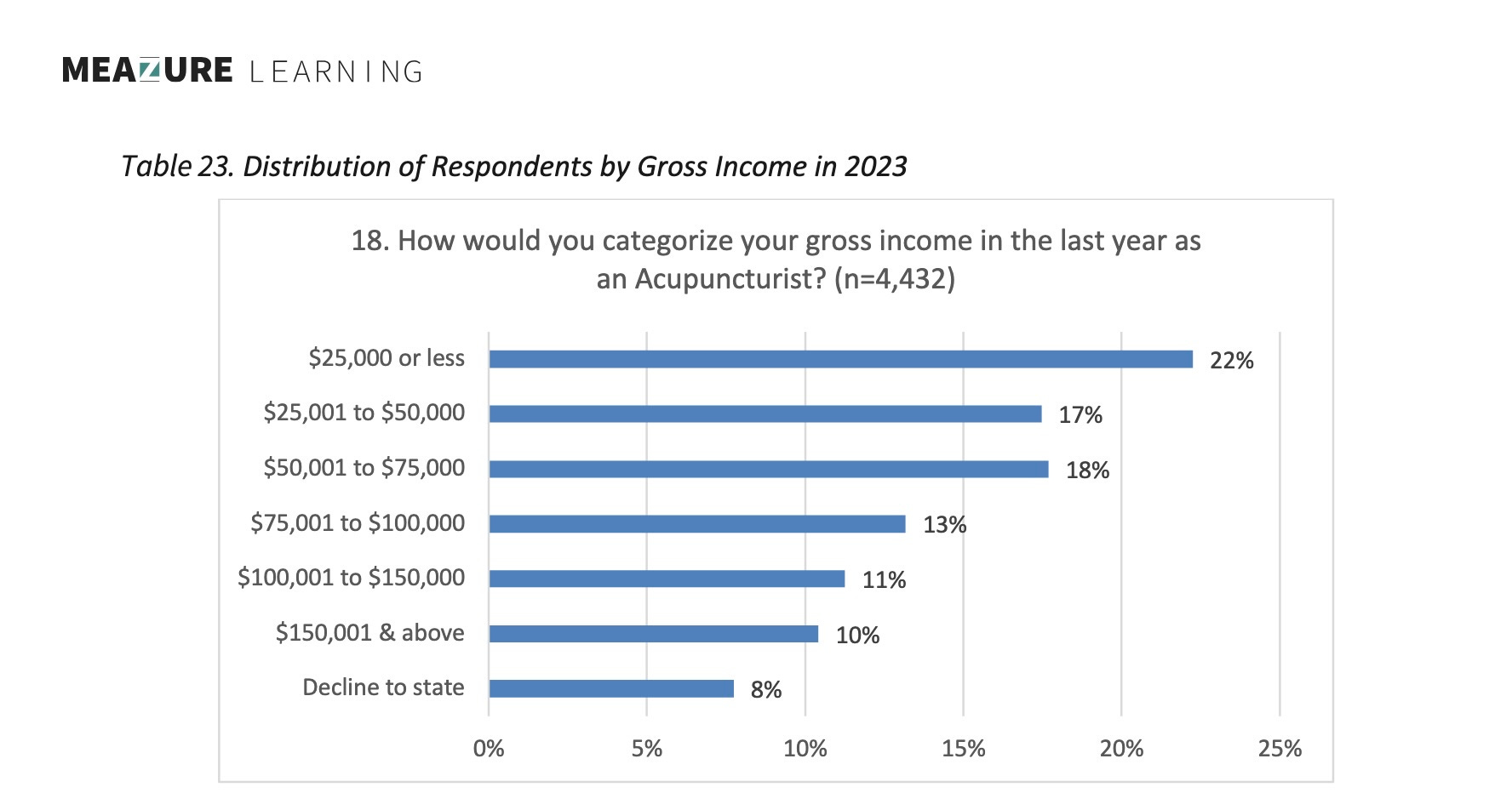
This is why our school has a tuition cap of $25K. But despite these dreadful numbers, plenty of acupuncturists still think that the entry-level credential for the profession should be a doctorate.
Did you try to warn anybody about the acupocalypse?
Many, many, many times. So did Elaine Wolf Komarow and Tyler Phan.
What part of the acupocalypse are you least looking forward to?
Wow, that’s a tough one. I think it’s a toss up between dealing with possible regulatory instability while running a school vs. what I’ve begun to think of as an incoming plague of frenemies.

Just putting that out there because I’m participating in an online panel discussion on Saturday and I’m worried that the Q & A portion could get ugly.
Regular readers of this Substack know that one of my themes, and a theme of our school, is that there’s no one right way to do acupuncture — only a variety of possible ways, some of them less costly and more user-friendly than others. I think of community acupuncture and conventional, private room acupuncture as apples and oranges. They both work, they’re just different. You can do things in a community acupuncture practice that you can’t do in a private acupuncture practice, and vice versa.
Many conventional acupuncturists, however, think of the comparison of private room acupuncture to community acupuncture NOT as apples to oranges, but as apples to apple peels, or apple pie to apple cores — or really, anything good involving apples to rotten, wormy apple trash. They look down on community acupuncture and they can’t hide it, even when they’re trying. Sometimes this is comical. As in, some people are beginning to panic about the acupocalypse precisely because our school is likely to be one of the only ones left, which would be a self-evident calamity. Acupuncturists are starting to say to me: wow, you were right, this situation IS really bad, it’s SO bad that you might be the survivors. We can’t let that happen!
There’s often a moment in acupocalypse conversations, when people recognize that our school represents a working solution to the debt-to-income problem, but they hate to see it in the same way they’d hate to see a cockroach. Nonetheless, sometimes they still want to talk to me about the acupocalypse. At length. I’ll be honest, there are only so many of these frenemy conversations that I can take.
Is there anything related to the acupocalypse that you DO want to talk about?
Actually yes. As a result of running an accredited school — really, I swear it’s just as accredited as every other accredited acupuncture school! — for a decade-plus, I’ve learned a few things and I wish people were interested in those lessons. I would like to talk about how hard it is to have an acupuncture school under any circumstances and how there’s no simple solution to the structural crisis of the acupocalypse. Both acupuncture education and the acupocalypse itself represent complex, multifaceted problems.
However, that’s not a popular topic. But guess what is?
Who’s the villain — or villains — responsible for the acupocalypse?
This might be surprising, coming from me, but I don’t think there is a villain. It would be much easier if there were. As many of you know, I’ve had a lot of conflict with a lot of people and organizations in the acupuncture profession over the years, including ACAHM, CCAHM, and NCBAHM. Regardless, none of my former (or current) adversaries is the Villain of the Acupocalypse.
On a certain level the entire acupuncture profession is to blame, but even that statement kind of misses the point. Fundamentally the acupocalypse is a money problem.
The acupocalypse is a function of the gulf between what it costs to educate acupuncturists (no matter how) and what acupuncturists earn (regardless of whether they’re practicing community acupuncture or conventional acupuncture). The problem encompasses big systems like higher education and occupational licensing, combined with how acupuncture is or isn’t valued in this culture, combined with the complexities of creating jobs in any industry let alone such a marginal one, multiplied by the challenges of small business and the affordability crisis. There’s no single, sweeping, magical solution, including: reviving apprenticeships2, making acupuncture a Bachelor’s level program instead of a Master’s, putting acupuncture programs in public institutions instead of private ones, or replicating our little school’s model elsewhere. Within every one of those strategies, money is still a problem.
So what can be done about the acupocalypse?
The acupocalypse is also a function of the gulf between our dreams for acupuncturist employment and cold, hard reality. Acupuncturists have a particular susceptibility to magical thinking — but applying magical thinking to the acupocalypse won’t make it better, it will make it worse.
In the short term (like, immediately) all acupuncture organizations should make a plan for the disruption that’s coming. 75% of the national acupuncture infrastructure is looking at the loss of half its revenue at least. Students who are thinking of enrolling in acupuncture schools should ask the schools what their acupocalypse-navigation plans look like.3 In general, prospective (and current) students need to understand the changes to federal financial aid and their impact. And acupuncture organizations should be focused on mitigating risks for students.
Ultimately the acupuncture profession needs to figure out how to educate entry-level practitioners without relying on student loans. (I’m exasperated because community acupuncturists DID figure this out, but you know, we’re trash.) In the medium term, my suggestion is to do a census of acupuncture jobs. Where higher education seems to be going, overall, is towards calibrating education to employment, and making employers more involved and responsible for training their future workforce. Acupuncturists should document the jobs that actually exist and map how they came to be — as opposed to touting the jobs that we think should exist or could exist if we just (insert strategy here). We need data; we don’t have it because historically, we couldn’t be troubled to collect it.
There aren’t that many acupuncture jobs, according to the Bureau of Labor Statistics: in 2023 there were 9370 W-2 acupuncture jobs in the US (only 150 of them in hospitals) and 570 of those were in Oregon. We could get more information about them if we made an honest effort. It would be good to know which employers and businesses, if any, are motivated to try to address the acupocalypse. Anyone out there want to try to save our little ecosystem?
I’m speaking as an employer who was motivated enough to participate in making an affordable school because my clinic needed acupuncturists: it’s all about who has skin in the game.
What do you mean by skin in the game?
The acupuncture profession does not lack big visions or people who feel passionate about promoting them. Talk is cheap, though, and what’s less clear is who’s going to risk their own resources to build new structures if/when existing ones fall apart, vs. who’s going to give up altogether and wander off, now that the era of federal student loan funding for acupuncture education is over. Who has — or who’s willing to put — skin in the game will determine the outcome of the acupocalypse.
Here again is the link to the panel discussion on Saturday March 21. Thanks to the White Pine Community for hosting and organizing it. I’ll try not to swear too much.
Recently CCAHM revisited this in the Joint Statement on Earnings Accountability Framework and Licensed Complementary Health: “these are majority-female professions (approximately 63% for Acupuncturists and 70-90% for Naturopathic Medicine), and the framework may inadvertently penalize programs for gender-based wage disparities affecting early-career earnings.” That’s less overtly blaming women for our terrible economic outcomes but it’s essentially the same argument and it still gets my hackles up.
I’m going to write about apprenticeships, I promise. It keeps getting bumped by other topics but it’s still on the list.
That includes prospective ORCCA students! We’re glad to have those conversations with you; we’re always happy when students are thinking about concrete, practical details.
Hi Lisa. I can feel the hackles and they are justified. I’m sorry your group has been treated so in this profession. Many are beginning to understand your movement has been grossly underestimated, which I imagine feels both vindicating and also really frustrating as things play out.
I have a teeth grit question. Have you, in all your spare time, ever considered starting a new professional acupuncture association (I know…eye roll provoking…because we need another one of those, right)? I ask because of your platform, which I believe is growing. You mentioned the need for actual data - I agree. I think data has been a major problem for lots of our issues - the acupocalypse, but also the drive for Medicare inclusion, the push for doctoral degree programs, scope expansions, cross-state license reciprocity, the basic naming of ourselves, etc. Full Consensus is a dream, probably, but even the concept of a “majority” seems out of reach to the acupuncture psyche because of lack of actual data. Not only does our profession obviously not have it, but it likes to tantrum when everyone isn’t on the same page and small groups begin working in different/opposing directions, thus furthering the divisions and disenfranchisement….as if not having consensus is a surprise. So we remain fringe as acupuncturists…with groups like yours the being the fringe of the fringe and therefore an easy target for the frustrations and blame by those with more ego invested. We need an organization that actually captures the thoughts of an actual “LOT” of the profession…not just the 10% of “participaters” who can both afford and stomach state association or NCBAHM diplomat membership for things like surveys.
I’m curious how many supporters you have participating, even if just out of curiosity, with POCA, as compared to the ASA’s maybe 5000 across all the state associations (that number from 2021 stats that Google reports). I feel like even AOF has better reach than the ASA. What is your reach in “members” or “supporters” compared to ASA? And…could it be the beginning chunk of an organization that is open enrollment, not state-membership gate-kept, is affordable (I’m thinking like the Chinese organizations who make their $ with classes and donations but only charge $25-50 annual membership), and whose mission is simply to seek an accurate pulse on where the profession actually is on issues as opposed to driving the profession’s issues (under the guise of “protect and promote) toward any particular agenda of a handful of motivated people. An association that does not contribute to the politicking or profit off practitioners, and is therefore not conflicted, but can objectively speak for the industry, would be invaluable. Special interest groups could then form for specific issues, and have the information needed to determine if their special interest is worth the interest and others could determine if those interests had reasonable expectations to succeed, which might encourage more investment and “skin” in the games needed in the political arena.
The barriers I often hear, (and have had myself), to “participating” are 1) membership is both energetically and financially expensive, even if it is considerably less than PT and MD organizations…they are less “poor” in general, 2) (arguably the biggest barrier) lack of alignment to specific agendas, and 3) burnout from historical attempts to participate and things not going the desired way.
I ask you, because you have created solutions to problems and have a platform to maybe start from. Maybe a research project for students😏. Just thoughts this post provoked.
Debt isn't just the central problem of the acupocalypse, It is the central problem of the apocalypse. We are not just mortgaging acupuncture student's futures, we are mortgaging all young people's futures. It seems acupuncture students just happen to be one of the first in line because of the highest DTI ratios. If we are interested in Liberation then this needs to be addressed and big ideas do have their place for honest reflection, however soapbox they may sound. You have figured out how to take action on a great idea and have truly created a remarkable clinic system & school. People are going to look to you (sorry).
I've noticed many do not want to look at debt probably because much of our livelihood, including retirement, specifically requires us NOT to look. So it's confusing - please bear with us. Or maybe we assume the next tech billionaire will somehow solve it. It's estimated only 10% of people understand how money is created which comes from typing it into existence without the bank having any real skin in the game - talk about magical thinking. We are then expected to not only pay back that fabricated amount (principal) but also pay back interest which usually amounts to double! Ummm....excuse me? This necessitates "growth". All civilizations who have used this magic end up in the same situation - how to maintain exponential growth in a finite world right? All civilizations who have been around the block have massive restrictions and outright forbiddance against this. Collapse isn't just a bug/cockroach problem, it's by design. We are starting to round the block.
I know this is way out of your hands/paygrade Lisa but my question to all - how does the acupocalypse (and all other current issues btw) stem back to this central issue, is this the central issue, and if so then how might we use this experience to help others navigate times ahead?