
A Time Capsule for the Acupocalypse


I was rummaging around the internet, looking for something else, when I came across a webpage about acupuncture schools that hasn’t been updated since 2002. It was like an archaeological find, a windfall that gave me perspective on our current situation, so I wanted to share it with you. (For readers who are new to the acupocalypse, you might want to read some FAQs first.)
Here it is, courtesy of Subhuti Dharmananda Ph.D of the Institute for Traditional Medicine. Subhuti has been exceptionally generous about organizing and sharing information — for decades — via the ITM website. I took screenshots because I was struck by the fear that someone at ITM would suddenly decided to update it, lol.
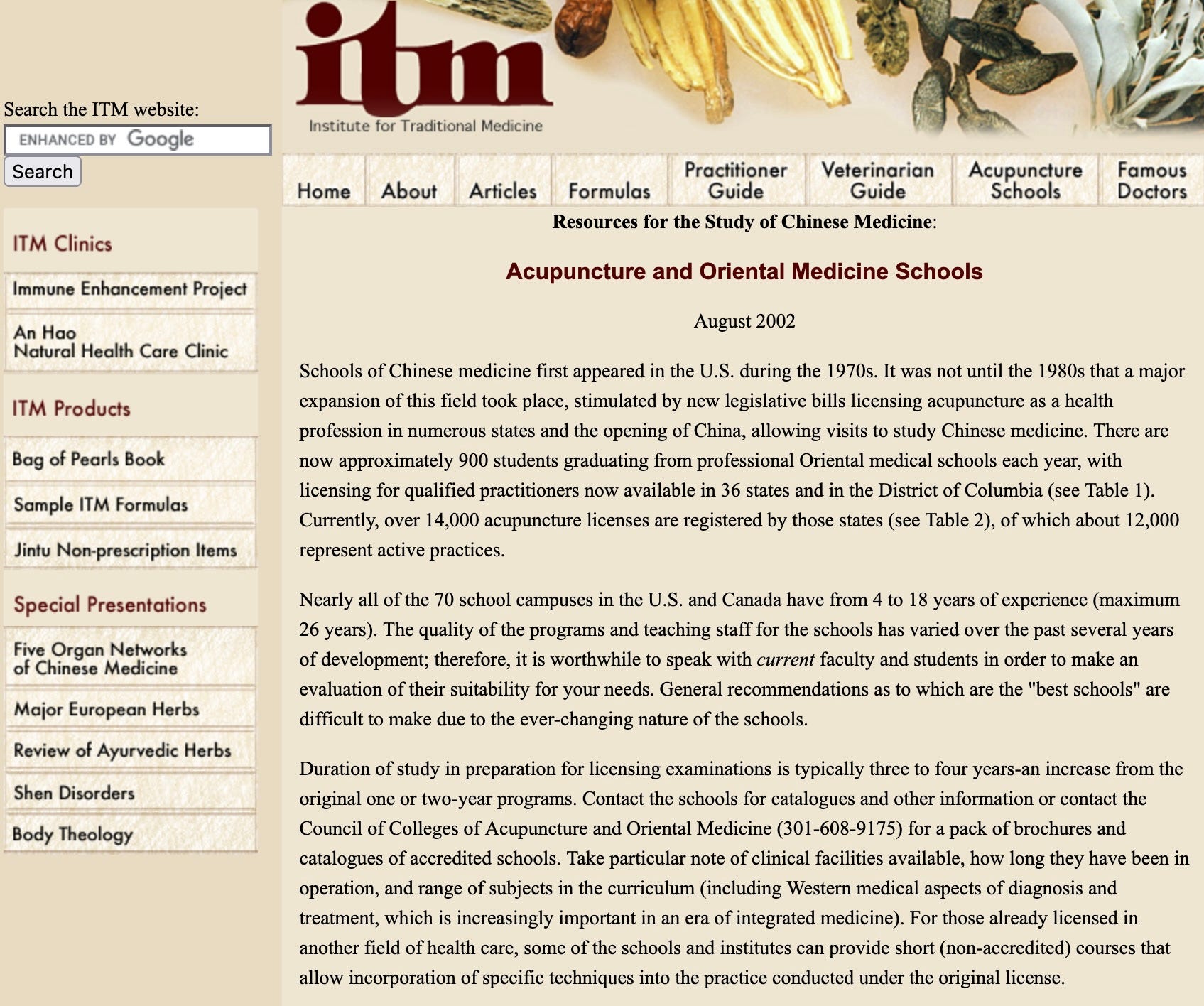
According to Subhuti, in 2002:
There were 14,000 licensed acupuncturists in the US, with some 900 new graduates entering the field every year. Oregon had 330 L.Acs. FWIW, my OR license number is 00254, and I got licensed in October 1994. So I’m surprised there weren’t more Oregon L.Acs in 2002.
There were 70 acupuncture school “campuses” in the US and Canada, with some schools having more than one location. When I started paying attention to this topic in the mid-aughts, I think there were about 65 ACAHM accredited programs in the US. According to Subhuti, most schools had 20 to 60 students enrolled per year in 3 and 4 year programs.
The idea of an acupuncture doctorate was “controversial”. (LOLsob)
The tuition cost for full time students ranged from $3,500 to $10,000 per year.
According to a survey that ITM conducted (no details included about how many people responded), the typical annual net income for an L.Ac was about $50,000 (range was $20,000-80,000) and practitioners saw about 35 patients per week. Subhuti noted that “most practitioners report that they have far fewer patients visiting them than they would ideally serve.” (When I had an in-person conversation with him in 2003, he told me that the average number of patients per acupuncturist in Portland was 12 per week, so it sounds like the survey must’ve had some geographic range.)
Let’s compare to 2026:
There are some 30,000 licensed acupuncturists in the US1 and 1469 in Oregon per the Oregon Medical Board’s website. According to ACAHM’s unduplicated headcount, in 2025 there were about 5500 students enrolled in 3 and 4 year programs, which suggests <1500 graduates per year (that’s my guess). There are currently 44 accredited programs. (Ours being one of them — I sure didn’t see that coming back in 2002!) The acupuncture doctorate is an established, passionately defended fact.2
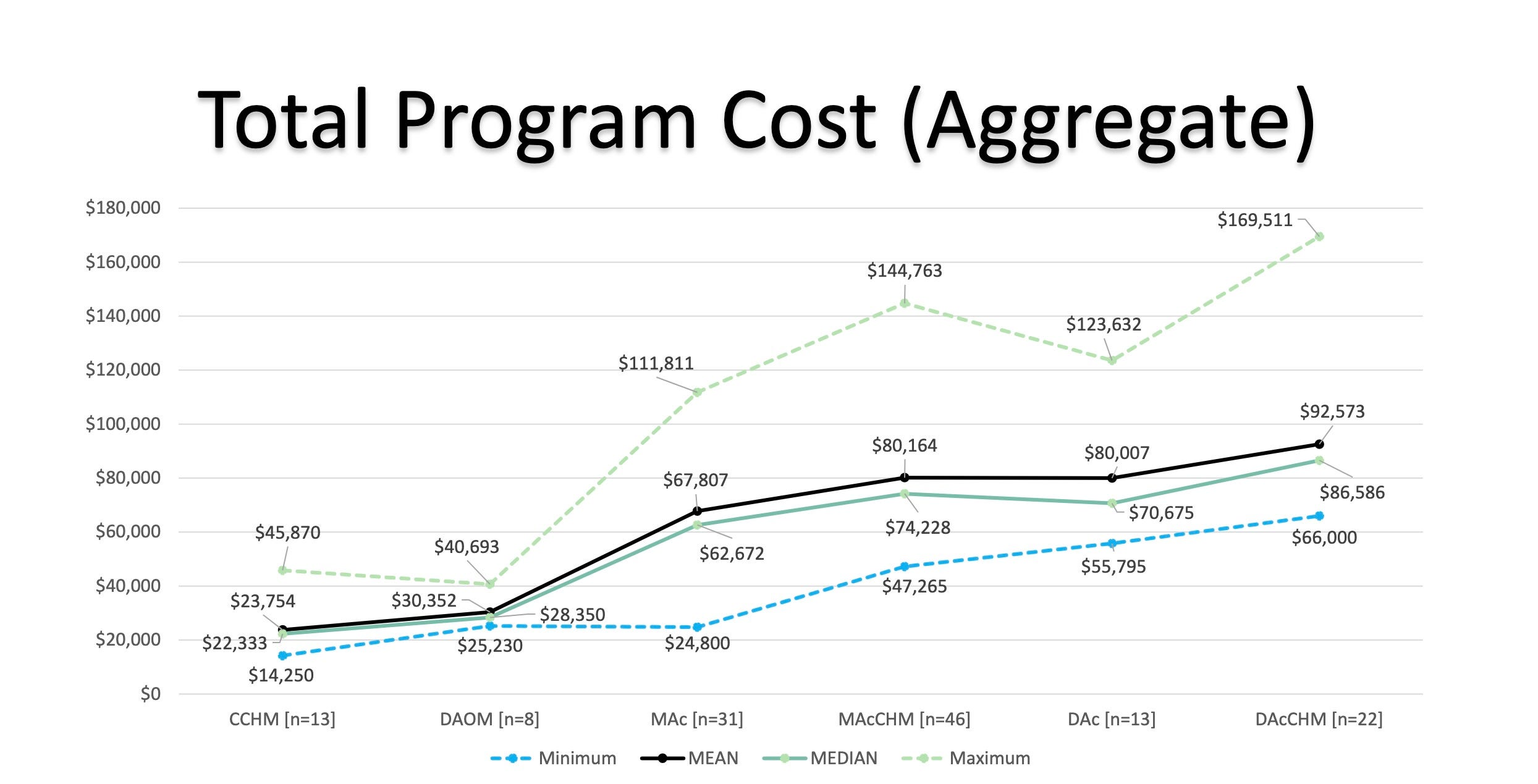
Per ACAHM’s 2025 Total Program Cost survey, the tuition cost for full time students in an entry-level program is now, uh, more than $3,500 to $10,000 per year (everywhere but ORCCA):
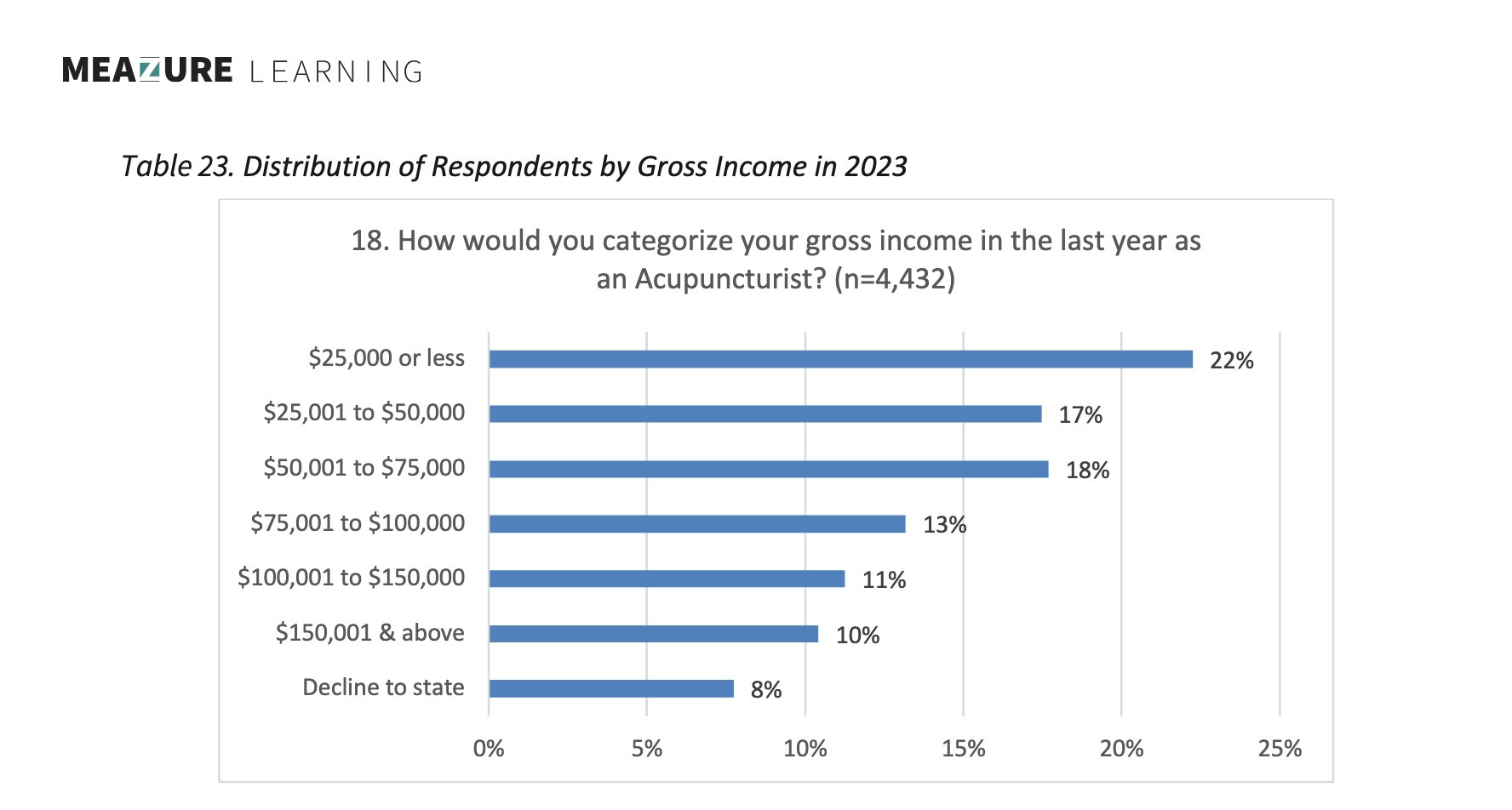
And for purposes of stark contrast, let’s revisit NCBAHM’s 2023 annual income numbers:
Lots has happened since I last wrote about the acupocalypse; the biggest change is that many more acupuncturists are now arguing about it. I’ve been listening in on the conversations and what strikes me most is how many people (on all sides of the debate) think that what the acupuncture profession needs to do, to respond to this crisis, is scale up. There seems to be an underlying belief that we can grow the profession in numbers and in wealth, if only we can get our act together.
For example, the most recent AHM Coalition Town Hall was dedicated to the idea that acupuncturists can and should earn more money in order to justify the cost of education (though that’s technically impossible, due to compound interest on student loans). We should all get better at billing insurance even though insurance reimbursements are going down.
Even conversations about how to adapt to the new financial aid limits for acupuncture schools — which include strategies like an entry-level bachelor’s and stackable degrees3 — seem to be grounded in a belief that there’s more money to be made if we can just get into the larger healthcare system somehow. Since there’s so much research now about how effective acupuncture is, there must also be a critical mass of well-paying jobs for acupuncturists somewhere —if only we can get schools to teach to mainstream medicine’s expectations.
The majority of acupuncturists, no matter what else they disagree on, seem to believe that we can transcend our small-business, self-employed reality of the last three decades. I find their conviction baffling — because there’s absolutely no indication that scaling up is economically possible for us as a profession.4
None of what acupuncturists are calling for now is fundamentally different from what the acupuncture profession’s been trying to do since the mid-90s. I’ve been around for all of it, and Subhuti’s webpage confirmed my sense of deja-vu — the acupuncture profession’s been trying to scale up this whole time. There’s always been a narrative that we’re on the cusp of transformation — at any moment we’re going to break through! Now with the acupocalypse approaching, that same narrative is showing up as a call for reforming or re-imagining the profession. THIS time we’ll get it right, or die — or maybe die trying?
This all feels surreal to me because from a business perspective, if you spend three decades trying to scale up and it doesn’t work, the logical next step is to scale back and stabilize. That goes double if your efforts left generations of acupuncturists in life-altering debt, and ultimately landed the acupuncture profession in an existential crisis.
A basic truth of business is that not everything can scale, just like not all plants can flower and not all birds can fly. Diversity is natural and there’s no guaranteed growth arc. The amount of money that acupuncturists earn and the way that we earn it has been consistent since 2002 (and if you adjust ITM’s survey for inflation, we’re earning much less now). The number of licensed acupuncturists has roughly doubled over 24 years, but as a profession we’re tiny and we should expect to remain so. We’ve never had a robust “workforce”; it’s never even been clear how many licensed acupuncturists were actually practicing. (For comparison, there are over 600,000 physical therapists in the US, most of them employed.) The Medical Industrial Complex has consistently declined to make jobs for us at any meaningful scale and there’s no evidence that’s going to change, no matter how much research we offer or how hard we grovel — because we have no leverage.

The basic size and shape of our profession have been consistent for decades. It’s our aspirations and the cost of education that are out of scale. And even as more acupuncturists are recognizing the destructive impact of student loans, most are still determined that we can somehow scale the profession to match our dreams. It’s like our own private version of Manifest Destiny.
What would it mean to us if we couldn’t scale up?
I wonder if the feeling of being part of an ever-expanding profession that will inexorably transform US healthcare is integral to some acupuncturists’ motivation to practice. Like, there has to be a grand narrative because just taking care of people isn’t inspiring enough? Which is unfortunate, not only because the grand narrative doesn’t align with not-so-grand reality, but because there’s so much that’s good about practicing acupuncture that has nothing to do with the profession’s scale or lack thereof.
2002 was also the year that I started the clinic that would become Working Class Acupuncture. There were no other L.Acs practicing in Cully even though Portland was considered “saturated” with acupuncturists. At the time, I was treating about 20 patients a week and wondering if I could make a living; I wasn’t paying attention to the state of the profession (though I had begun to get a clue that my acupuncture school had deceived me about my prospects.)
I was also falling in love with small business in a way I’m only appreciating now, 24 years later. In a sense WCA did scale up (though obviously not the way the acupuncture profession wants to). WCA is still — and always — a small business; we’re absolutely dependent on our community of patients, particularly our regulars. The money that we make, almost $1 million annually, is mostly in ~$25 increments paid by individual humans.
Across every stage of WCA’s development, small business offered me dignity, purpose, autonomy, and creativity, all of which I needed desperately and which I couldn’t have gotten anywhere else. I’m way too weird for normal employment. And outside of small business, there was no avenue for me as an acupuncturist to have a relationship with my own community — the Medical Industrial Complex certainly couldn’t give it to me.
I had to build the relationship myself, and it became a powerfully stabilizing force in my life. Huh, maybe this is a theme? The acupuncture profession loves the idea of transformation — transforming patients, transforming healthcare, transforming itself — while I’m wary and skeptical. I love the stability that acupuncture can offer, particularly to people with chronic conditions and people experiencing transformations that they didn’t ask for and don’t want. (AKA loss, all kinds of loss). I love the way that acupuncture can accompany people through hard things, and I love how WCA shows up to do that — day in, day out; year in, year out.
Stabilization at the right scale, even when it’s a small scale, is a gift. Speaking from personal experience, it can be the foundation for a life. I wish the acupuncture profession valued it more.
See also: the spring 2011 edition of The American Acupuncturist, page 25, that cites 27,000 L.Acs in the US. In an August 2023 article on “Governing Therapeutic Pluralism”, Nadine Ijaz and Heather Carrie estimated the number of licensed acupuncturists in the U.S. to be approximately 28,000. It’s quite difficult to count licensed acupuncturists across 50 states; after corresponding with the authors, they noted that 28,000 might be a typo and the number of L.Acs might be approximately 29,000. The discrepancy points to the challenge — even for academic researchers — of obtaining a firm number from the patchwork of acupuncture regulatory bodies. A recent headcount by the POCA Cooperative also put the number of L.Acs in the US at around 30,000.
I appreciate Matt Bauer’s recent reminder that the entry-level doctorate really was controversial and the profession in 2005 was evenly divided on it. It’s easy to forget that acupuncture history is written by the winners.
Don’t get me wrong, I still think we should try everything. But also I expect that a lot of what we try won’t work, because that’s entrepreneurship in a nutshell.
True confession, I’m probably influenced by the experience of watching somebody try to scale up my business model and fail spectacularly, venture capital and movie stars notwithstanding:
On Selling Out, Part Two

Back in November, subscriber Clay Daulton wrote: “Can you please do a follow up to the On Selling Out post, now that Modern Acupuncture’s franchise is down to 8 locations? Modern Acupuncture was a business catastrophe for many L.Ac./ non-L.Ac. owners around the country and for the franchise itself. I’m …
The conversations in our profession always lack context. Such as, what is happening in higher ed on the whole (private liberal arts schools closing in high numbers), and doctors in private practice going out of network.
This bit is so interesting -- "The majority of acupuncturists, no matter what else they disagree on, seem to believe that we can transcend our small-business, self-employed reality of the last three decades." Because, in practice (in both senses) even those same acupuncturists still seem to really want to practice in a small-business, self-employed way. For all the talk about jobs, I see a lot of people complaining about the pay for the jobs that are there, the skills and expectations of the people applying for the jobs, etc. They want the perks they think would come with jobs, but complain about how they are expected to practice.
I suspect it is like the conversations about taking insurance -- participation in the system was pursued because of the fantasies about what it would mean (recognition from the system, treating people who couldn't otherwise afford acupuncture, saving the system money) than the reality. And ditto for the Doctorate. Everything that's been done is based on a fantasy, and the folks pushing the changes are committed to supporting the fantasy.