
On Being a Good Example
interview with Arielle Avenia, L.Ac of Cohort 9

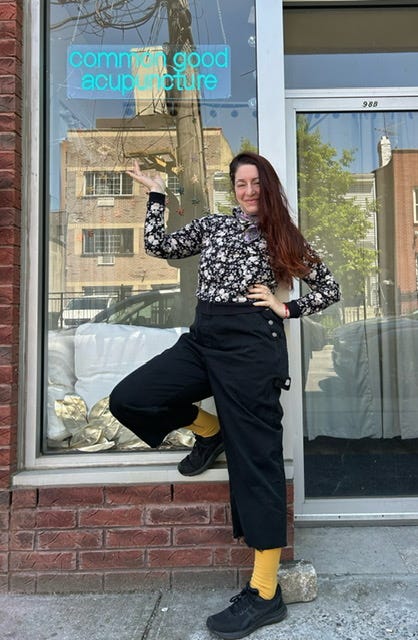
As many of you know, one of ORCCA’s recent graduates opened a community acupuncture clinic in Brooklyn, NY — Common Good Acupuncture — and is writing a Substack about the experience. Part of having an acupuncture school is analyzing our graduates’ outcomes, so I asked Arielle to help me with that. Arielle graciously agreed. Here’s our conversation:
One of the main goals we had in mind when we started ORCCA was to close the gap between acupuncture school and acupuncture practice. Because unfortunately, for a lot of people, there’s a huge chasm between the experience of their education and their subsequent experience with small business, and they sort of fall in and can’t get out — so they never actually have a practice. Since you just started your practice and you’ve recently navigated that gap, can you describe what it’s like?
I started out with a plan to begin my practice the same way I began my internship: don’t fall off the rolling stool, follow the order of operations, have a checklist and the consent paperwork ready. Be organized.
The conversation I’m having with patients is the exact same conversation I was having as an intern: welcome, what can I do for you, here’s how the clinic works. Today is for you to figure out if you like this, if you like my way of practicing. If you do, here’s my treatment plan suggestion.
And the treatments I’m doing are very similar to the treatments I did at the beginning of my internship, I’m keeping things very simple because there’s so much else to think about with a new clinic. I’m doing a lot of Miriam Lee 10 plus some symptomatic Master Tung points. Everyone gets ear needles because everyone is stressed! 90% of my patients so far have neck and upper back issues, and the points for those are also points that treat insomnia. So I’m developing protocols to address the complaints I see over and over.
I feel like I’m mostly on autopilot, because I’ve been doing this exact work for 2 years. The space was a big push to complete, and now that’s its mostly done, the remaining parts are figuring out how to do marketing.
And in setting up the space, I inadvertently imported a WCA Hillsdale vibe! I’ve recreated a sense of familiarity from student clinic.
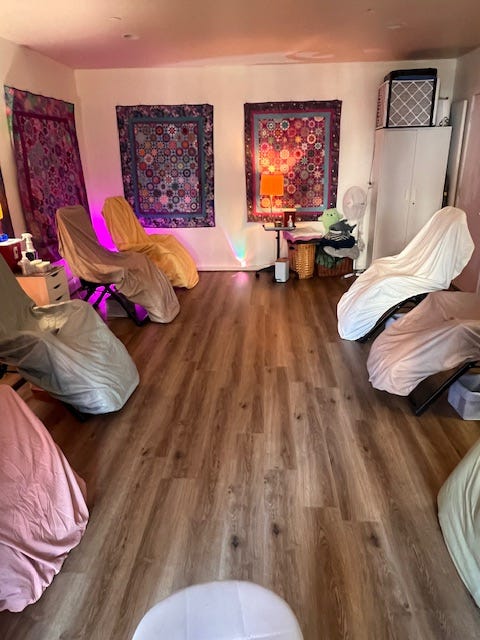


It’s not hard to have command of the space because the space is so small. A big difference of course is the entrance; there’s only a curtain between the entry and the treatment area. I don’t want to do everything chair-side and I don’t want to create a culture of shushing people. I could use more sound insulation, and I’m working on signs for the front door.
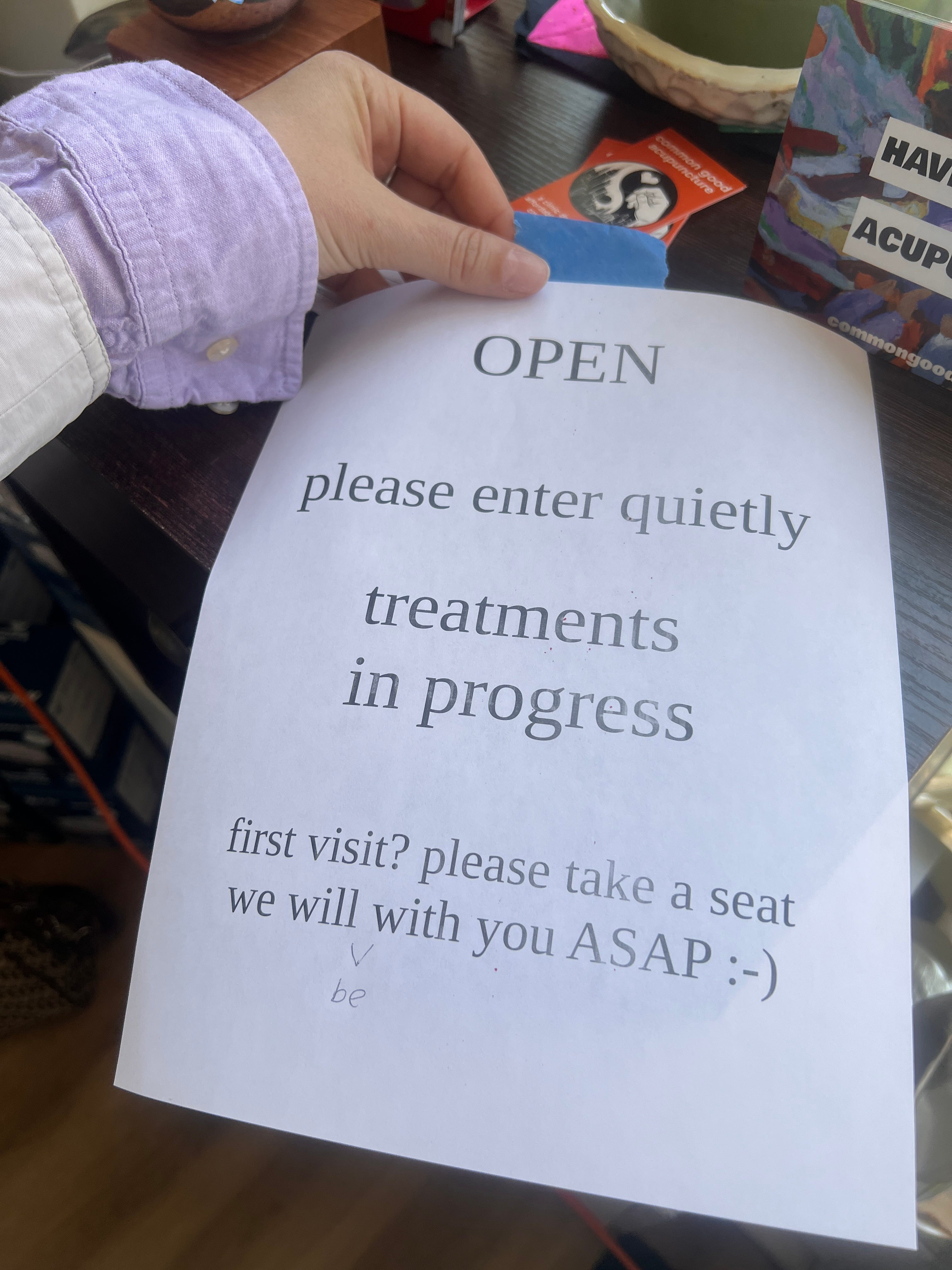
I only had to figure out how to adapt the clinic format to the specifics of the space itself, everything else I mostly knew how to do already.
The experience that ORCCA grads get in student clinic is INDISPENSABLE. We go through every part of doing the job and that creates a muscle memory. It’s one thing to read about something but it’s a completely other thing to have it in your body because you’ve been doing it.
That said, in terms of the gap between finishing school and starting the clinic, there was a lot of uncertainty to tolerate. The licensing process took months for no reason other than the speed of bureaucracy and the lease negotiations also took more time than I anticipated. Once I had the keys, it took me only three weeks to open the space. It would have been faster but I didn’t understand the value of paint primer and had to teach myself how to install laminate flooring.
You have to have the tolerance for waiting, for going through what it takes to find and then vibe check your space (and also your landlord). You have to be able to build relationships. You have to be able to navigate your community. Above all you need courage. I already had it in my mind to do all of this, back when I started acupuncture school — but the moment of pulling the trigger was really scary.
THIS IS NOT EASY. Opening a clinic is scary, and it takes a lot of commitment. And it requires the sacrifice of my ability to live a wild and free life. But this clinic, this job, this is how I express my love for people — in this specific and direct way — and this is what I want.
And my friends have been so fucking supportive. They’re signal-boosting constantly for the clinic, they’re coming in and getting treated, it’s been amazing.
We’re working on making a very explicit inventory of what ORCCA can provide for students vs. what they need to bring to the table themselves. What are your thoughts on that?
I think about it as, when you’re going to acupuncture school, you are buying yourself a job — so you have to know that you want the job that’s coming at the end of it. It’s not a “wait and see” situation. If you’re not sure, it’s a waste of time and money and a drain on the organization. There needs to be a kind of inner persistence that makes you want to keep going; you need momentum because life keeps happening, both while you’re in school and after you graduate.
At the end of the day, you’re buying yourself a future career, otherwise why are you spending all this money?
Speaking of money, having it is a really important thing. I spent around $20K in cash out of pocket to open the clinic — I saved for it. That doesn’t include licensing fees and moving cross country. I also have a car and that was indispensable. I knew this was what I wanted to be doing, I changed my lifestyle in order to do this.
Month 1, I made about half of my expenses in two weeks. Month 2 I’m already in the black because of having a gig providing acupuncture for a corporate retreat. This opportunity came to me through a long term relationship with a friend who is a powerhouse creative event planner; there might be more opportunities of this kind. What I’m saying is, you have to figure out how this is going to work financially for you.
You were all in before you even got to ORCCA. As your memoir shows:

Yes. My experience of acupuncture, receiving it myself, was enough to make me want (passionately) to make it available to others. For some students that probably isn’t true, and they gain clarity through the program; they acquire more will along the way, as they treat patients and they grow the hunger for doing it.
The school can give you the experience of systems that work to run a clinic, but it can’t make it happen for you. What attracted me to the program was that it was clear that I had to be self-motivated and self-responsible. I knew that from the admissions materials and it was hammered into us as students early-on, which is different than most other educational experiences I have had — it’s not codependent.
My experience with opening my clinic has just been more of the same. In small business, you’re accountable to yourself. There’s nobody looking over my shoulder, saying, “Now remember you have to switch your Con Edison account from your personal one to your business” or any of the other thousand little tasks. The biggest challenge is showing up for myself and keeping the energy up, especially on slow days.
Some of this is the leadership piece — having that orientation and practicing self-leadership was necessary to get the clinic open. Having gotten to this point, I’m feeling that I’m now in a leadership position, and looking for ways to use this, particularly by having monthly offerings of various kinds. Organizing the free 5NP clinic and the volunteers for May Day was a great experience.
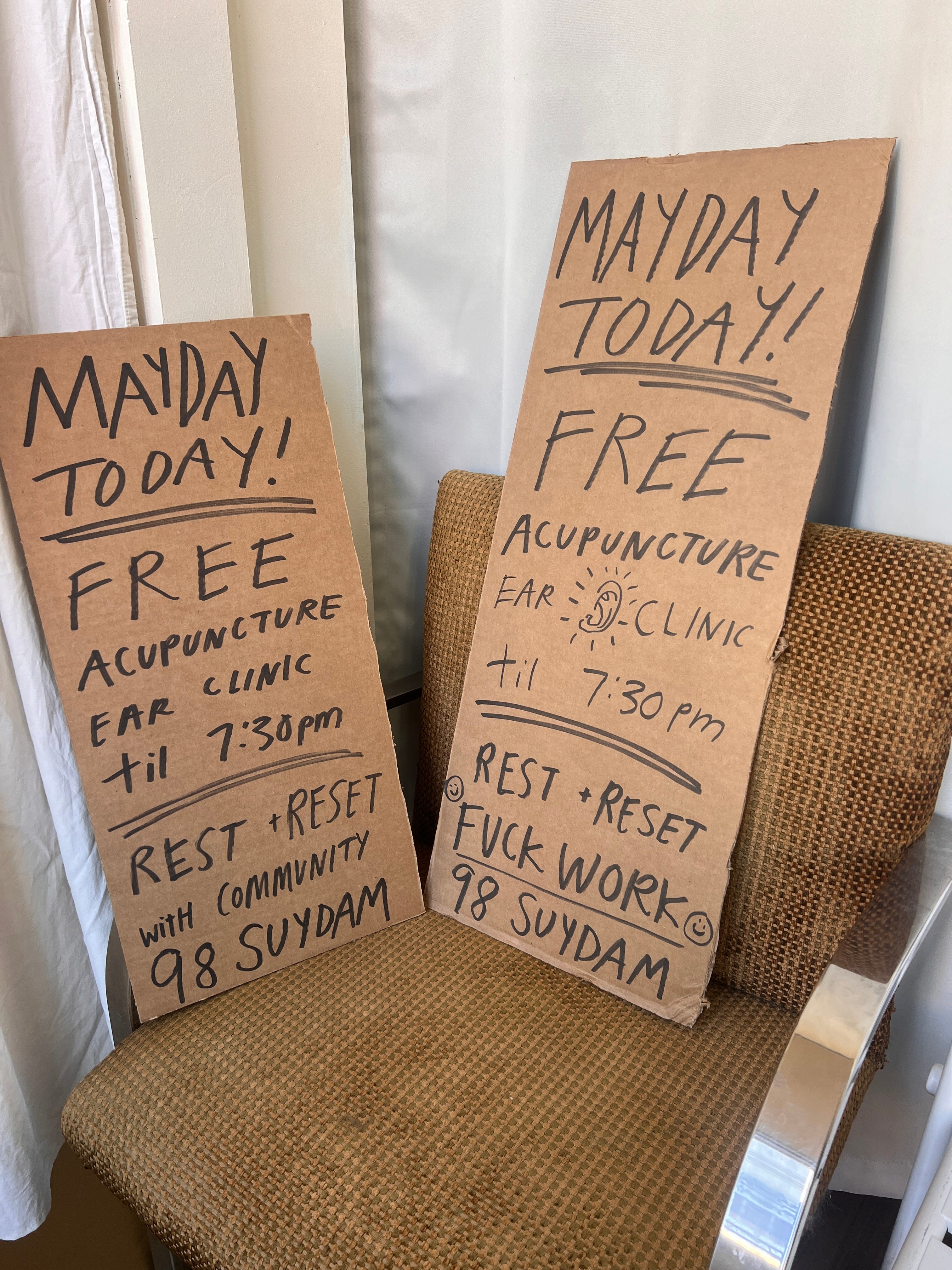
New York has 5NP certification but it turns out there are very few people who are actually organizing opportunities for 5NP practitioners to use their skills. When I thought about May Day, I chose not to reach out to licensed acupuncturists because you know, they’re trying to make money — but 5NP folks just want to needle people. I got connected with some 5NP practitioners and emailed everybody on the list who wasn’t an L.Ac. And some of them were excited to participate.
For me it was very cool to be able to give the 5NP volunteers the space and the opportunity to do their thing — to put on an acupuncture event at an acupuncture clinic, where the infrastructure already exists because we do community treatments all the time. (I have the only WCA-modeled community clinic that I know of in NYC.) I ran the reception part and they did the needling. I thought of it as: I will create the container, and then other people can flex their skills in that container. To make an opportunity for other people to do the work, as opposed to only doing it myself.
We treated 34 patients and for some of them it was their first acupuncture experience ever. One person was just walking by and decided to come in on the spur of the moment. And it was really interesting, the last patient of the night had this huge emotional release, there was nobody else there by that point, so they had space to do it.
I’m feeling very inspired by this. We already have dates planned for June and July for more free clinics.
I think the theme of this interview is really about you being a good example.
Okaaayyyy…That makes me feel squeamish, but do your thing.
No, seriously! You’re a good example! I think people need to see examples of self-leadership in practice.
Unfortunately we have a pretty dis-empowered culture, in general. I’m often wondering, why aren’t people more excited to be doing stuff? At this point I think it is because we’re largely tired, overworked, overwhelmed, and financially stretched thin. Luckily community acupuncture does a great job addressing those things haha.
I think this quote from your memoir really applies:
SO YOU WANNA DO A THING (instructions)
1) Get an idea for a thing. Like a project. But it could be anything. Something that is worth you spending your one precious life on earth doing. Or something that is funny (that’s a good use of time). Something you’re just curious about seeing exist (art). Something that is useful (benefits self and/or society). Don’t do a thing for evil (people will spit on your grave and hate you).
2) Make a plan for the idea, in sequential steps. Be realistic. Be specific. Each step might have micro steps. Write an outline detailing all of this. Make a time line to estimate long it will take.
3) Research information, skills, expenses, and other resources to do your project as outlined by the logistics in your step-planning. It might take money. And if not money, time. And help. Do you have people to help? Hire people? Money to hire people? Get your shit together, with gusto.
After all of this maybe you hate the thing. That is fine. Now is a good time to abandon. It can remain a perfect idea in your heart for forever. Or you can plague the people around you by endlessly talking about it and never doing it, because you did not get your shit together, or maybe you are a coward, or maybe you need 10 men in historically accurate armor. Whatever. Care a little and figure it out.
4) Do the thing- encounter problems and/or success. Learn from problems and/or success. Spend way more, way less, or just-on-budget. Take way longer or way less time. Do the thing!!!
Since I’ve successfully embarrassed you so far, let’s end on the same theme: we’re all really, really proud of you for doing the thing!
Subscribe to Arielle’s Substack here:
@commongoodacu on Instagram
Love following your story Arielle! What a beautiful clinic you have created!
This quote is gold. Congratulations for your new job.
"But this clinic, this job, this is how I express my love for people — in this specific and direct way — and this is what I want."